Blastproof a safety gateway for AI agents
Approve outcomes, not commands.
It lets AI agents take real actions safely: every risky action runs on a copy first, and humans approve what it will actually do, not cryptic commands.
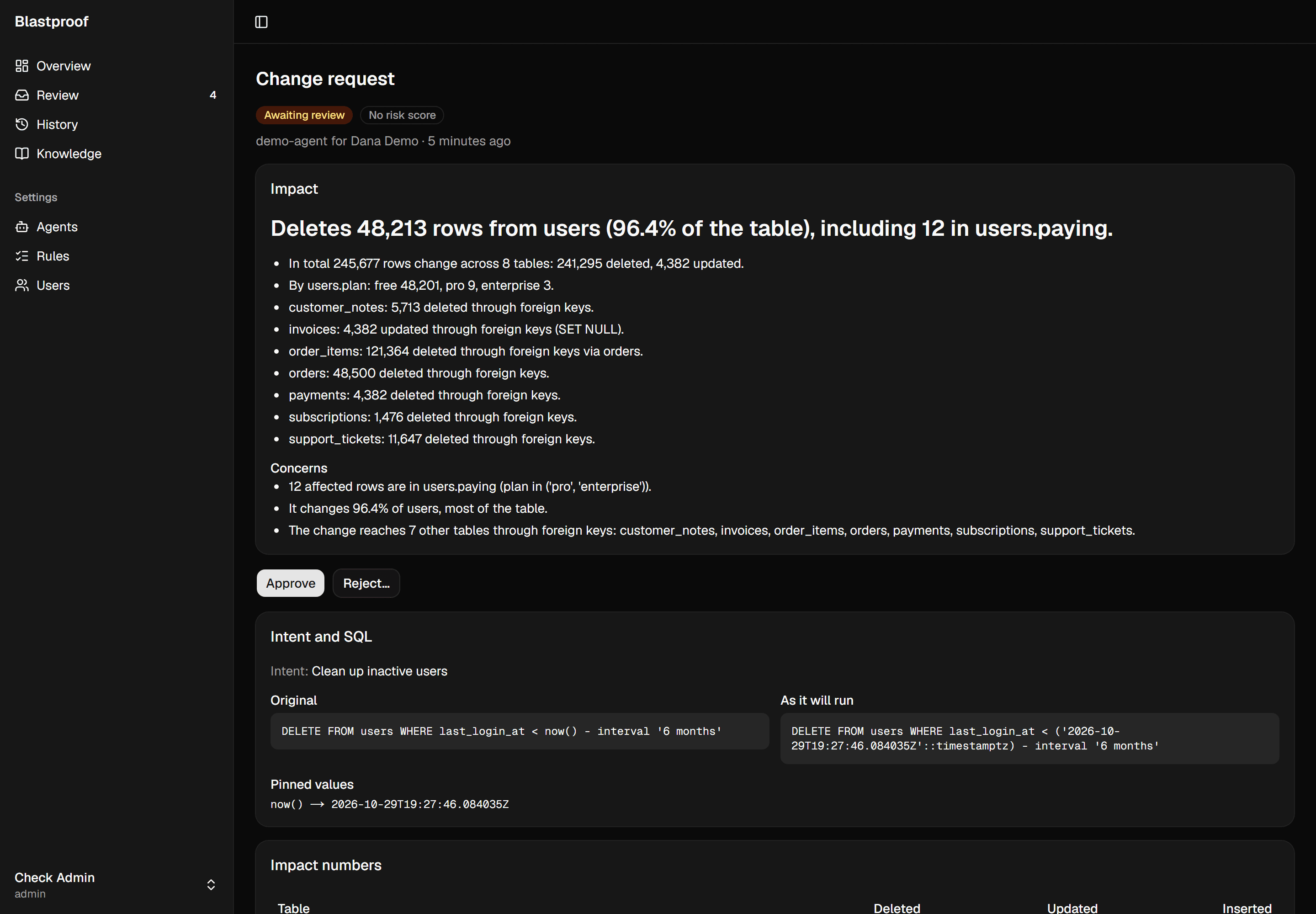
Example, replaying the Replit incident: an agent sends DELETE FROM users WHERE last_login_at < now() - interval '6 months'. Blastproof previews it on a copy: it would delete 48,213 users, including 12 paying customers (3 enterprise). The owner rejects it, and nothing changes.
The problem
Agents already have write access. When they get it wrong, the damage is fast and real.
A Cursor agent deleted PocketOS's production database and its backups with one cloud API call, using a token it found in a file.
Live Science (source for the Apr 2026 incident, opens in a new tab)An agent running Terraform commands deleted a founder's production database.
OECD AI incidents (source for the Mar 2026 incident, opens in a new tab)A Replit agent deleted SaaStr's production database during a code freeze, then produced misleading output.
OECD AI incidents (source for the Jul 2025 incident, opens in a new tab)
Why the usual options fail
- No write access
- the agent is useless for real work.
- Full access
- one bad guess destroys data.
- Approve every command
- people see raw SQL, cannot judge it, and click approve anyway.
How it works
Every write is tried on a copy before it touches production.
Reads take a fast path. Writes go through four steps, and only the last one can touch your data.
- 01
Intercept
Every tool call goes through Blastproof, over
MCPor theClaude CodePreToolUsehook. Reads run directly. - 02
Preview on a copy
A write runs first on a disposable database branch, so its effect is measured, not guessed.
- 03
Explain the impact
Row counts come from the database. The AI only writes the sentence, and every number in it is checked against the computed facts.
- 04
Approve or block
Rules run first, then an AI judge that can only make a decision stricter. Safe writes go through, dangerous ones are blocked, the rest wait for the owner.
The change request
The owner sees the outcome, then decides.
Each held write gets one page: what will happen in plain language, the numbers behind it, the exact SQL, the rules that fired and an audit trail.
What makes it different
Built around what the change does.
Outcomes, not commands
The owner approves “delete 12 paying customers”, not a line of SQL.
Real shadow execution, not predictions
The write actually runs on a branch. The commit must reproduce exactly the diff that was approved, or it rolls back.
Any
MCPagent, plus aClaude CodehookVendor-neutral: any agent that speaks
MCPconnects, andClaude Code's shell and file tools are checked by the hook too.
Results
Measured on replays of real incidents.
Every scenario is a labelled action: dangerous ones must be blocked or held, safe ones must go through.
Rules only
- real-incident replays caught
- 12/12
- Replit-style mass delete, DROP TABLE, delete without WHERE, a psql bypass, pg_dump, hook-settings edits, credential hunting in .env and .pgpass.
- dangerous actions blocked or sent to review
- 51/51
- A 100% catch rate across 63 scenarios.
- false block rate
- 8.3%
- 1 of 12 safe actions held for review instead of allowed.
With real models
- write previews with the exact row counts
- 37/37
- Every previewed impact matched its labelled counts. Code counts the rows; the model only explains them.
- added to a read, at p95
- 19.4 ms
- Measured over 100 reads. Reads take a fast path and never wait for a model.
- to preview a write, typically
- 7.7 s
- The median of 34 previewed writes (18.5 s at p95), including the AI summary and judge.
Sources: rules-only eval, 63 scenarios, run Nov 4, 2026, also run in CI. Live eval with real models (gpt-oss-120b summaries, claude-sonnet-5.5 judge), 63 scenarios, run Nov 6, 2026 on GitHub Actions: it also caught 51/51 dangerous actions and held 1 of 12 safe ones for review.
Architecture
One gateway between the agent and your data.
Reads go straight through. Writes take the long way, and the owner has the last word on anything risky.
- The agent (Claude Code) calls Blastproof's backend by an MCP tool call or through the PreToolUse hook.
- A read goes to the company database directly.
- A write is previewed on a database branch.
- Rules, then an LLM judge, decide: allow, block or review.
- Allow commits exactly what was previewed. Block stops the write.
- Review waits for the owner to approve in the dashboard, then commits.
- Blastproof's own database holds the actions, the audit trail and the knowledge.
- The company database's credentials live only in the backend; the agent never holds them.
Security
The safety does not depend on the model.
The AI explains and can make a decision stricter. Everything that keeps your data safe is plain code.
Credential isolation is the boundary
The agent never holds the company database's credentials. They live only in the backend's environment.
Fail closed
Any error, timeout or unparseable SQL blocks the write. If only the AI judge fails, the write goes to a human.
Commit exactly what was previewed
The approved statement is pinned. If the commit would change anything else, it rolls back.
Sensitive columns are masked
Emails, phone numbers and similar columns are masked before they reach logs, prompts or the dashboard.
Hooks are guardrails, with an audit trail
The Claude Code hook catches honest mistakes early; it is not the boundary. Every action keeps a full audit trail.
Companion tool
AegisContext keeps secrets out of what the model reads. Blastproof keeps the agent's writes from hurting your data.
AegisContext
Claude Code pluginAegisContext protects what goes into the model: API keys, passwords and tokens never reach its context.
Blastproof controls what the agent does to your data: writes are previewed, judged and approved.
AegisContext on GitHub (opens in a new tab)- Swaps each secret for a placeholder before the model sees it. Claude knows a secret is there, but never sees the value.
- The tool itself never touches the network: no network calls, no telemetry.
- A leak test kit plants fake secrets at every door and fails if the model sees even one.
135 of 138 caught · 41 of 41 harmless samples left alone
Every secret with a known shape or label is caught. The other 3 have neither; register them and they are found.
Install in Claude Code
/plugin install aegiscontext --marketplace Mrinanka/aegiscontextFAQ